Palletizing Automation Trends: The Shift to AI and Software
November 2, 2026
Automation in manufacturing is expanding beyond core production processes into end-of-line operations such as packaging, material handling, and palletizing. In particular, palletizing—the process of stacking finished products or boxes onto pallets—is one of the most common applications for industrial automation due to its repetitive nature and the physical demands of handling heavy loads.
Traditionally, palletizing involved repeatedly stacking boxes of uniform dimensions in predefined patterns. However, the growing adoption of high-mix, low-volume production, increasing numbers of stock keeping units (SKUs), and more diverse operating conditions have significantly raised the technical requirements for automation solutions.
From collaborative robots and high-speed industrial robotic systems to intelligent solutions powered by 3D vision and AI algorithms, palletizing automation continues to evolve. In this article, we explore three major trends shaping palletizing automation in manufacturing and logistics, along with the key considerations for successful implementation.
01. Three Key Trends in Palletizing Automation
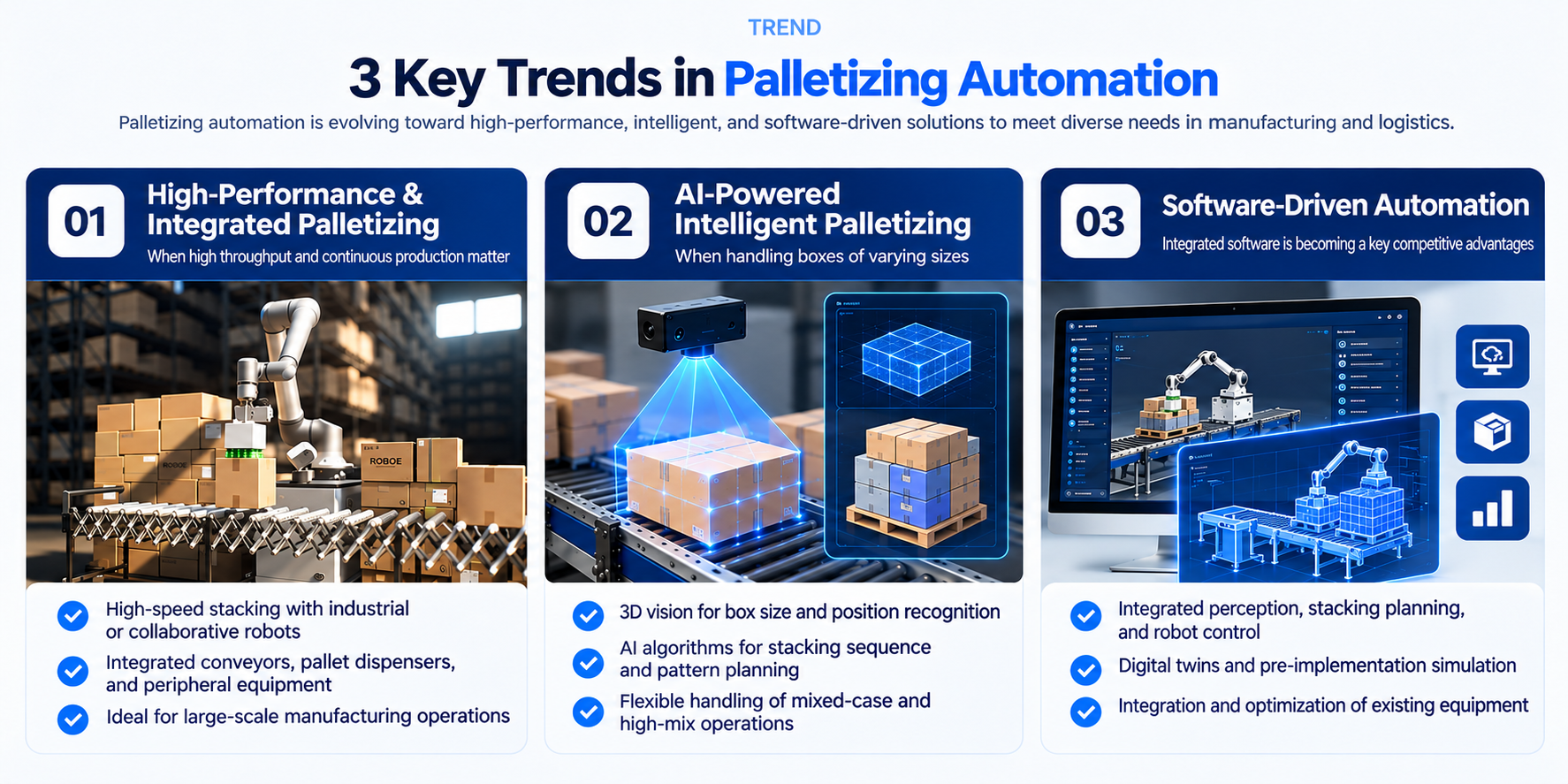
① High-Performance and Integrated Palletizing — When Throughput and Continuous Production Matter
High-performance, integrated palletizing systems are particularly suitable for large-scale manufacturing operations where high throughput and seamless integration with production equipment are essential. These systems combine industrial robots or collaborative robots with multiple conveyors, pallet dispensing systems, material handling equipment, and safety systems to automate entire end-of-line processes. For operations handling products from multiple production lines or requiring rapid palletizing of heavy loads, key selection criteria include robot payload capacity, operating speed, and integration capabilities with surrounding equipment.
However, as the scope of automation expands, initial investment costs, space requirements, and engineering complexity associated with system integration may also increase. For this reason, integrated palletizing systems are generally well suited to manufacturers with consistent production volumes and demanding throughput requirements.
② AI-Powered Intelligent Palletizing — When Box Sizes and Handling Conditions Vary
AI-powered palletizing is designed to improve automation flexibility in environments where product dimensions, positions, and stacking conditions frequently change. At the core of these solutions are 3D vision systems that identify the position and dimensions of boxes, combined with software that determines stacking sequences and plans robot motion paths.
In manufacturing and logistics environments where boxes of different sizes are handled together, conventional approaches based on predefined palletizing patterns can become difficult to maintain. To address these challenges, robotic solution providers are developing systems that combine AI-based perception technologies with intelligent stacking algorithms. The growing demand for intelligent palletizing is closely related to the increasing complexity of logistics operations. Rather than simply stacking identical boxes according to fixed patterns, modern logistics facilities increasingly require robots to recognize, evaluate, and handle boxes of varying sizes and types in real time.
At ROBOE Technologies, we integrate proprietary technologies such as 3D vision, AI-based software, and simulation with robotic hardware, including collaborative robots, to support flexible automation in complex logistics environments. By collecting and analyzing operational data and improving the coordination between hardware and software, ROBOE aims to establish a continuous feedback loop that supports ongoing system optimization.
These developments demonstrate how the competitive advantage of palletizing automation is expanding beyond robotic hardware to include visual perception, stacking optimization, motion planning, and control software. Nevertheless, the feasibility and performance of AI-powered palletizing systems depend on factors such as product characteristics, packaging conditions, operating speed, and the vision environment. Site-specific testing and validation therefore remain essential.
③ From Hardware Performance to Software-Driven Automation
When implementing robotic automation, payload capacity and operating speed are important, but they are not the only factors that determine success. The ability to operate reliably under real-world conditions is equally critical.
Manufacturing and logistics facilities differ in the types of products they handle, available workspace, and requirements for integrating existing equipment.
As a result, successful robotic automation increasingly depends on software capabilities such as object recognition, robot motion planning, palletizing pattern generation, and process simulation.
System integrators (SIs) play a critical role in this process. SIs combine robots with peripheral equipment and design automation systems tailored to each customer's operating environment. However, technologies such as mixed-case recognition, intelligent stacking algorithms, complex robot motion planning, and simulation often require specialized development and validation.
For AI-powered automation projects, the ability to integrate robotic hardware, vision systems, and software can therefore become a major factor in overall project success.
Against this backdrop, collaboration between robotic solution providers with proprietary software capabilities and system integrators can help reduce implementation complexity and support more efficient automation deployment.
02. How AI and 3D Vision Are Transforming Palletizing Automation
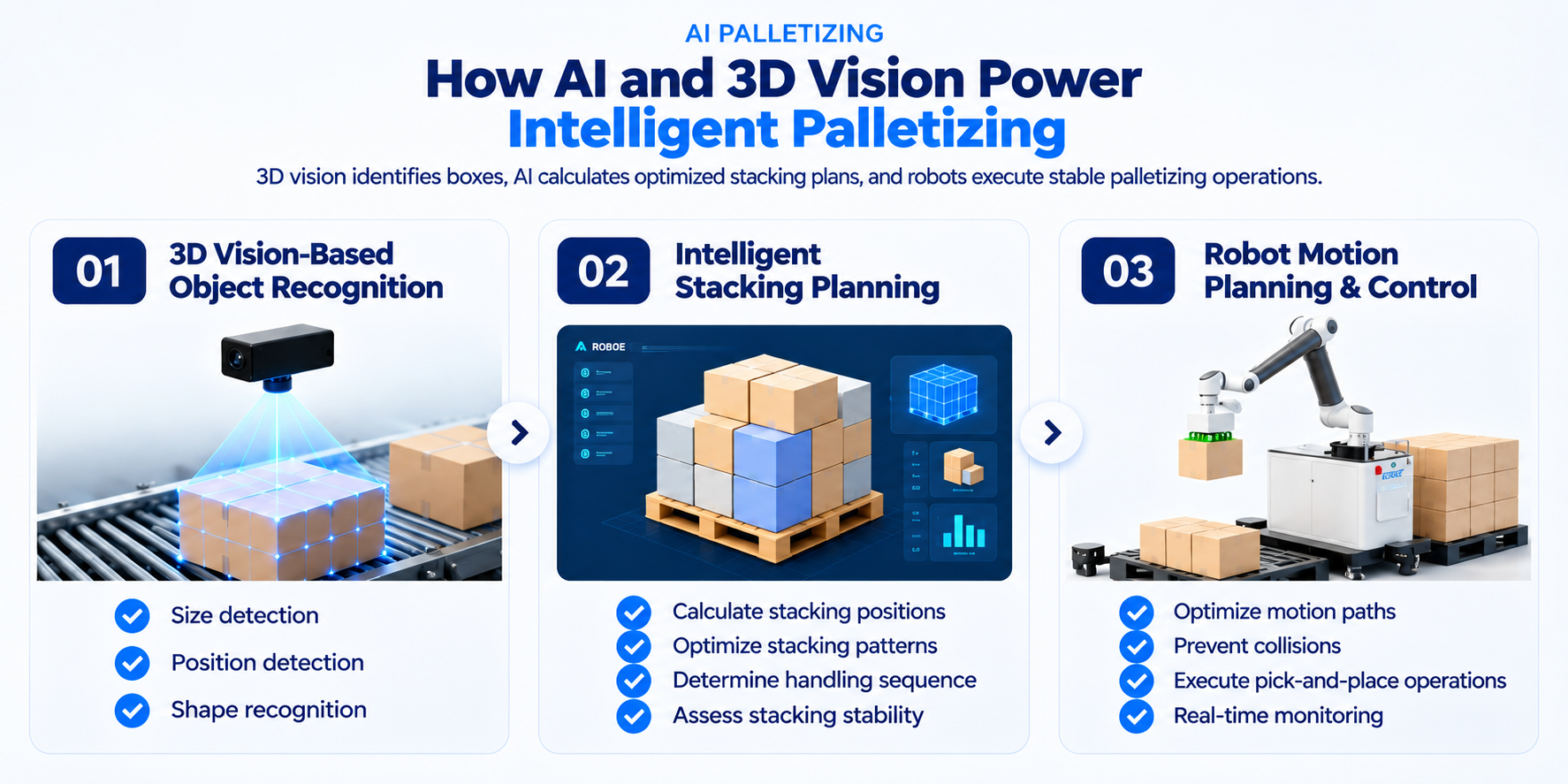
AI and 3D vision are becoming increasingly important in palletizing automation because they enable robotic systems to respond more flexibly to changing handling conditions. Traditional fixed-pattern palletizing remains effective for operations involving uniform boxes stacked in predefined positions.
However, when product dimensions and positions change frequently, or when different types of boxes must be stacked on the same pallet, more adaptive technologies are required. AI-powered palletizing systems address these challenges through three core capabilities.
* 3D Vision-Based Object Recognition
3D vision enables robots to identify the position, dimensions, and spatial arrangement of objects. Unlike conventional 2D imaging, 3D vision captures depth information, allowing robotic systems to estimate the height and position of boxes in three-dimensional space.
This capability is particularly important in logistics centers where boxes of different shapes and sizes are handled together. Accurately identifying cargo positions and determining which objects can be safely handled are essential steps in robotic palletizing and depalletizing.
Major global robot manufacturers and automation solution providers are also incorporating vision systems and 3D cameras into robotic applications to support more flexible object handling.
* Intelligent Palletizing and Stacking Optimization
Intelligent stacking software calculates box placement positions, stacking patterns, and handling sequences based on detected cargo dimensions and palletizing requirements.
In mixed-case palletizing, boxes of different sizes and weights must be stacked onto the same pallet. This requires the system to consider not only space utilization but also load stability, weight distribution, and the sequence in which boxes are handled.
Intelligent palletizing algorithms help coordinate these requirements and generate stacking plans suited to varying operational conditions.
* Robot Motion Planning and Control
Robot motion planning determines how a robot moves between pickup and placement positions while accounting for object locations and the surrounding environment. In practical applications, motion planning may also involve collision avoidance, robot reachability, and coordination with conveyors or other equipment.
These capabilities are especially important in mixed-case palletizing and depalletizing, where cargo positions may vary and stacking arrangements may be irregular. Together, 3D vision, intelligent stacking algorithms, and robot motion control expand the range of manufacturing and logistics applications that can be automated.
As palletizing systems become more intelligent, software capabilities related to perception, decision-making, and control are expected to play an increasingly important role alongside robotic hardware performance.
03. Beyond Technology Selection: Why Implementation Planning Matters
Successful palletizing automation requires more than selecting and installing a robot.
To build a system that performs reliably in real manufacturing and logistics environments, companies must evaluate product characteristics, operating conditions, throughput requirements, and compatibility with existing equipment. Three factors are particularly important when planning a palletizing automation project.
* Site Assessment and Feasibility Testing: Before implementation, companies should evaluate site-specific constraints and operating conditions. These include available floor space, packaging materials, reflective tape, damaged or deformed boxes, lighting conditions, and other factors that may affect robotic handling and vision performance.
Early testing helps identify potential technical limitations and determine whether the proposed automation system is suitable for the intended application.
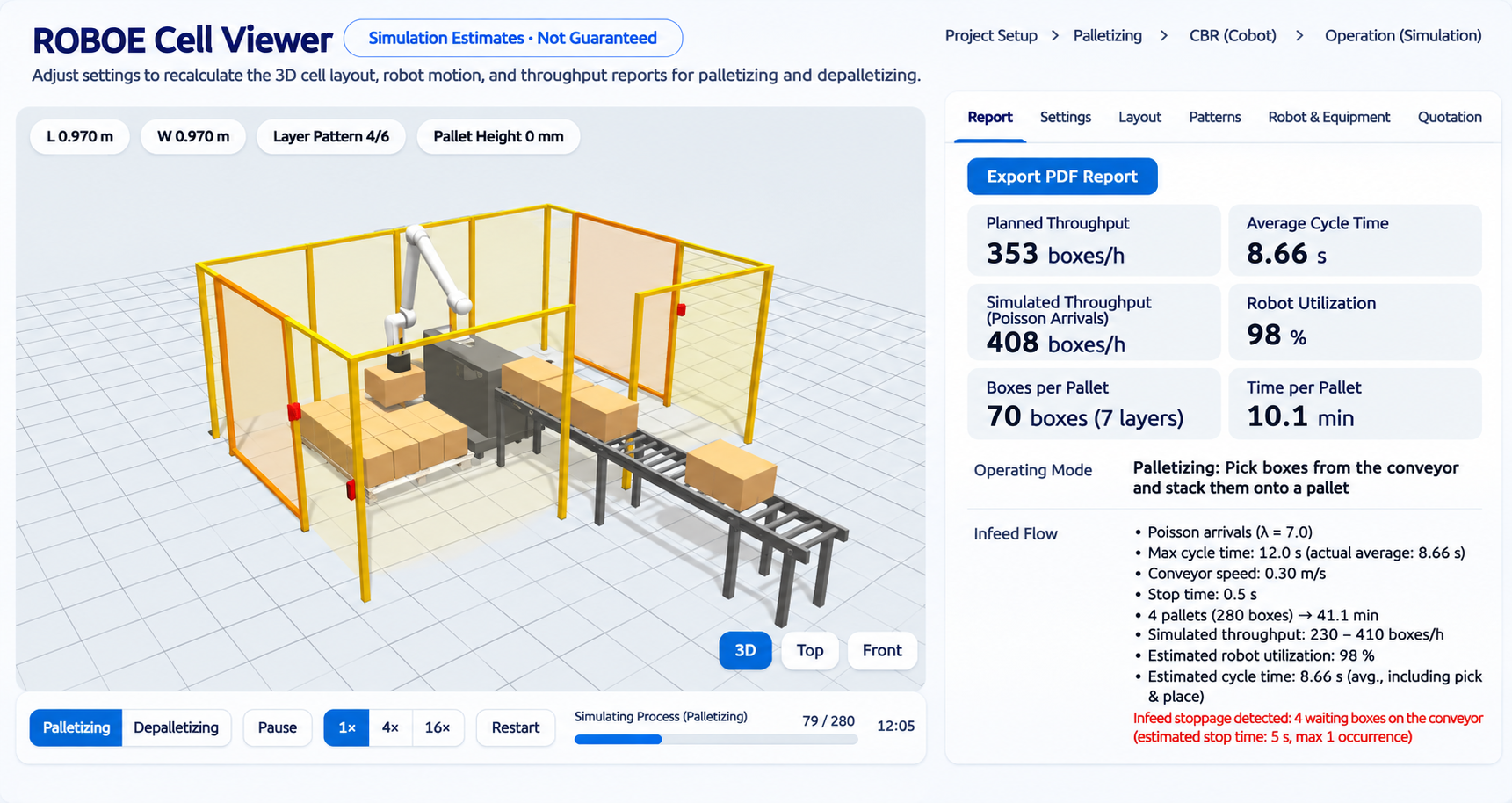
* Digital Twin and Pre-Implementation Simulation: Digital twin technology and process simulation can help companies evaluate automation performance before physical deployment. Some advanced automation projects use historical order data, product specifications, and operational requirements to simulate proposed palletizing processes.
These simulations can help estimate expected throughput, evaluate stacking stability, identify potential bottlenecks, and assess the potential return on investment (ROI). Although simulation results cannot guarantee actual operating performance, they provide valuable information for system design and investment decisions.
* Selecting a Partner with Strong Software Capabilities: As palletizing systems become more sophisticated, selecting an automation partner requires evaluating more than robotic hardware specifications.
Companies should consider whether a solution provider can integrate vision technologies, control algorithms, process simulation, and surrounding equipment into a reliable automation system. A partner with strong software and system integration capabilities can help address technical challenges during both the planning and implementation stages.
How ROBOE Technologies Supports Automation Planning
At ROBOE Technologies, we apply AI and software technologies to palletizing automation to support customers and system integrators throughout the planning process. Based on site-specific information including product types, box dimensions, conveyor configurations, surrounding equipment, and pallet dimensions. we develop simulation-based visualizations of proposed automation systems.
These visualizations can provide estimates of expected throughput and illustrate how robotic systems may operate within existing production or logistics environments. By presenting operational scenarios and projected performance data, ROBOE helps customers and system integrators better understand the potential productivity improvements and practical benefits of automation before deployment.
Conclusion: The Future of Palletizing Is Intelligent and Software-Driven
Palletizing automation is evolving beyond repetitive material handling toward intelligent control and flexible stacking. While robot payload capacity, speed, and mechanical reliability remain essential, technologies such as 3D vision, AI-based perception, intelligent stacking algorithms, motion planning, and simulation are becoming increasingly important.
To achieve better automation outcomes and improve potential ROI, manufacturers and logistics operators should evaluate hardware performance alongside software capabilities, site requirements, and system integration expertise.
By combining intelligent palletizing technologies with thorough implementation planning and available support programs, businesses can pursue more flexible, efficient, and economically viable automation strategies.
References
[1] RoboticsTomorrow (2025.10.21)
UR20 Cobot Enables New Palletizing Opportunity at Bob's Red Mill
[2] RoboticsTomorrow (2025.03.06)
Photoneo and Jacobi Robotics Partner to Deliver AI-Powered Robotic Automation for Warehouses
[3] The Robot Report (2024.07.11)
Jacobi Robotics raises $5M for motion planning software
Writer: Mike Oitzman
https://www.therobotreport.com/company-tag/jacobi-robot/
[4] RoboticsTomorrow (2026.04.08)
Jacobi Robotics Signs Collaboration with ABB Robotics to Bring AI-Powered Palletizing to ABB's Integrator Network