Why Is Palletizing Automation Still Challenging?
November 12, 2026
Palletizing has long been one of the most widely adopted applications of industrial automation. However, many successful robotic palletizing systems have primarily been deployed in large-scale warehouses and distribution centers. Small and medium-sized operations, meanwhile, continue to rely heavily on manual labor. The reason is not necessarily a lack of robotic hardware. Rather, businesses face several practical challenges when implementing palletizing automation in real-world environments.
In this article, we explore five major barriers to palletizing automation and discuss how businesses can overcome them through advanced technologies, system integration, and real-world applications.
Why Is Palletizing Automation Still Challenging?
5 Key Barriers and How to Overcome Them
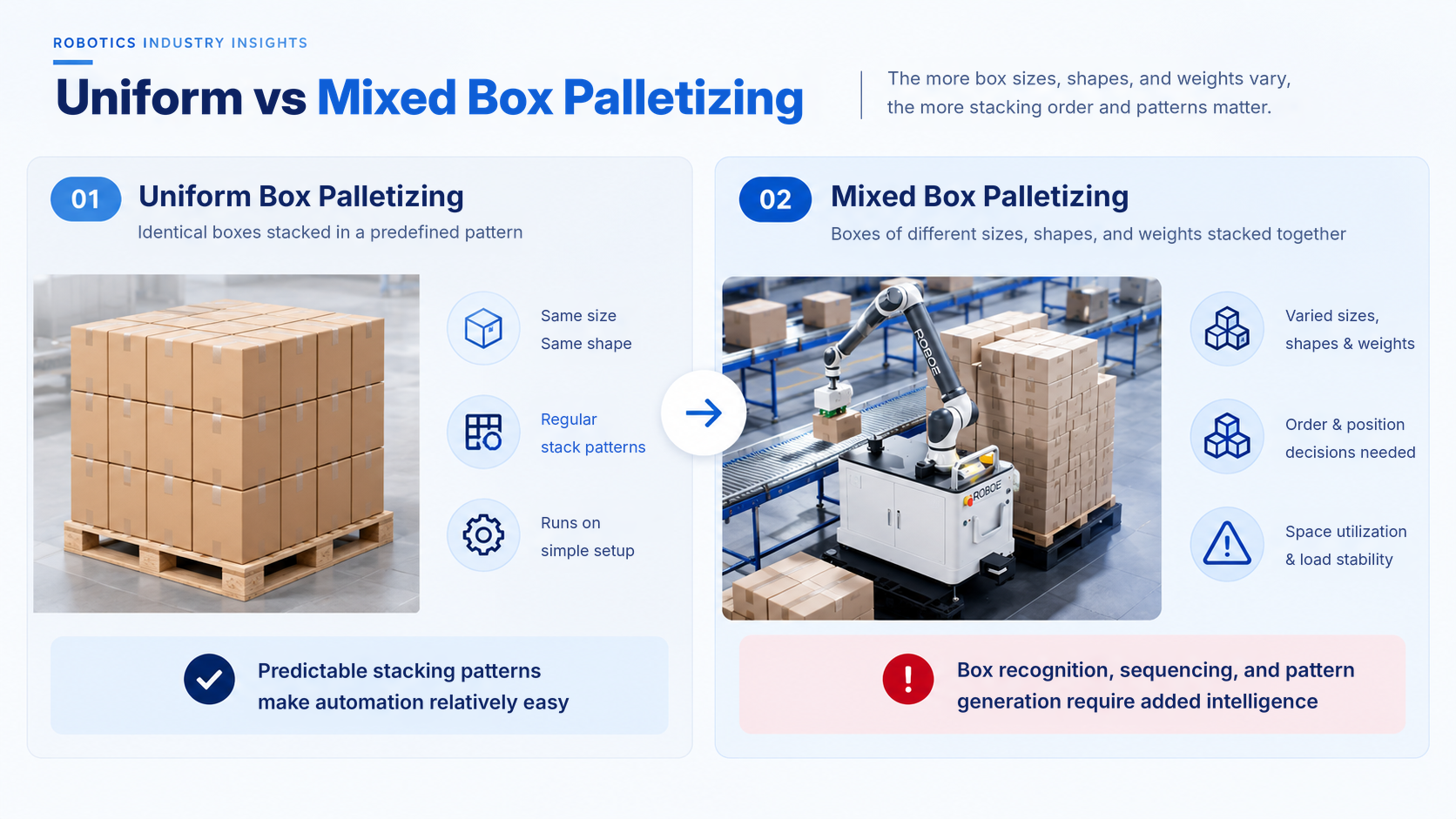
1. Mixed-Case Palletizing: When Standard Stacking Patterns No Longer Work
At first glance, palletizing may seem like a simple, repetitive task. However, many manufacturing and logistics operations handle a wide variety of products in relatively small quantities. Boxes differ in size, shape, and weight, while stacking requirements frequently change.
These conditions make fully automated palletizing more challenging. The problem is particularly noticeable in small and medium-sized distribution centers. Boxes of different dimensions arrive together, available floor space is limited, and palletizing requirements vary from one pallet to another.
Historically, such high-mix, low-volume operations have been considered difficult to automate efficiently. Even major logistics companies face similar challenges. For example, a large logistics company introduced a portable robotic palletizing system at a major distribution facility in the Seoul metropolitan area. The system uses AI-powered vision to identify box dimensions in real time and stack boxes according to their destinations.
Boxes that cannot immediately be placed in an optimal stacking arrangement are temporarily stored in a buffer area and subsequently palletized in a more efficient sequence.
This demonstrates that mixed-case palletizing requires more than simply picking and placing boxes. The system must also determine what to stack and in which order. Similar challenges exist in depalletizing operations. As product varieties and packaging formats continue to expand, cases, trays, and packaging materials are becoming smaller and thinner. Consequently, robotic systems must handle an increasingly diverse range of items and operating conditions.
2. Space Constraints and Robot Safety Requirements
Traditional industrial robotic palletizing systems typically require safety fencing, resulting in relatively large installation footprints. These systems often involve complex programming and extensive integration work, which can increase deployment time.
Additionally, pallet replacement may require temporarily stopping operations or installing automated pallet-changing equipment, adding further costs. For small and medium-sized businesses with limited floor space, these requirements can become significant barriers to automation. To address these challenges, collaborative robots, commonly known as cobots, have become an increasingly popular alternative to conventional industrial robots.
Collaborative robotic palletizing systems can offer several advantages, including:
-Smaller installation footprints
-Potential operation without traditional safety fencing, depending on risk assessment results
-Compatibility with 220V power supplies in certain configurations
-Greater flexibility for relocation and reinstallation
However, it is important to note that collaborative robots do not automatically eliminate the need for safety fencing or other protective measures. Appropriate safeguards must be determined through a comprehensive risk assessment. ROBOE Technologies has implemented collaborative robotic palletizing solutions across various industries, including logistics and food and beverage manufacturing, helping businesses reduce the space required for automation.
3. Throughput and Production Line Integration
Installing a robot is one thing. Ensuring that it operates reliably within an existing production line is another. To prevent bottlenecks, the speed at which boxes arrive on a conveyor must be coordinated with the robot's handling capacity.
Other factors, including stacking height, pallet positioning, and integration with existing equipment, must also be considered. Importantly, a robot's maximum rated throughput does not necessarily represent the actual productivity achievable in a specific facility.
Several factors influence the overall cycle time:
-Distance between the picking and placing positions
-Gripper engagement and release time
-Robot movement and positioning
-Pallet replacement procedures
-Coordination with conveyors and surrounding equipment
The Association for Advancing Automation (A3), through Automate.org, highlights the importance of optimizing robot placement, conveyor layouts, movement paths, and equipment operating times to reduce cycle times in robotic material-handling applications.
Synchronizing conveyor and robot movements can also help minimize unnecessary stops and restarts. This illustrates an important principle: successful palletizing automation is not simply about choosing the fastest robot. It is about designing a system that fits the material flow, operating requirements, and physical constraints of the facility.
When evaluating robotic palletizing solutions, businesses should therefore examine more than robot payload and maximum throughput. Actual box arrival rates, robot travel distances, stacking patterns, and pallet replacement times must all be considered.
Where necessary, preliminary 3D process simulation can help evaluate robot reach, estimated cycle times, and potential bottlenecks before installation.
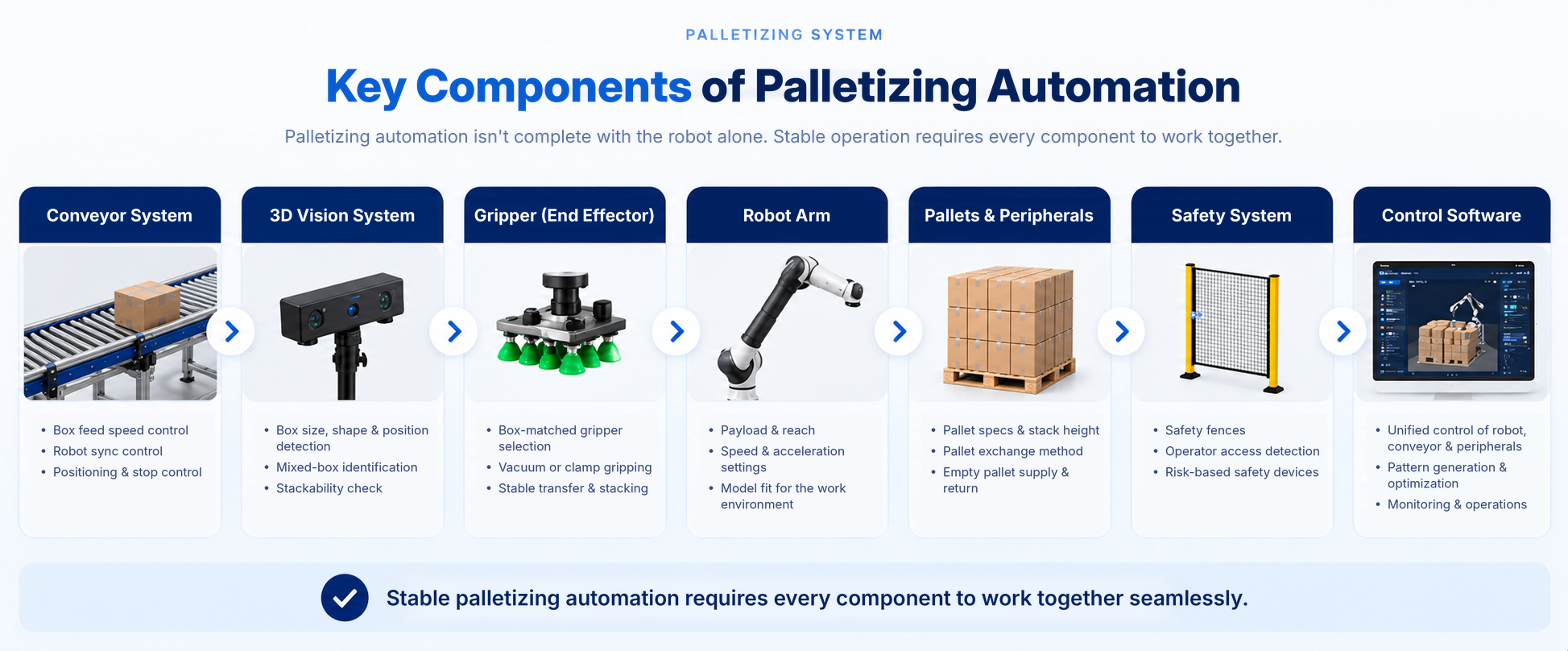
4. System Design, Component Sourcing, and Technical Integration
Palletizing automation involves much more than purchasing a robot.
Building a complete robotic palletizing system requires the integration of multiple components, including:
-Industrial or collaborative robots
-Grippers and end-effectors
-Conveyors
-Vision systems
-Safety equipment
-Robot control software
The challenge is that these components cannot operate independently. They must work together as part of a coordinated automation process. For example, even if a robot has sufficient payload capacity, palletizing may fail if the gripper cannot securely handle the boxes or if the vision system cannot accurately identify their positions on the conveyor. For small and medium-sized businesses with limited automation experience, selecting and integrating these components can be particularly demanding.
Companies must compare technologies and specifications from robot manufacturers, gripper suppliers, and system integrators. They must also consider equipment configuration, maintenance requirements, and the ability to accommodate new product specifications after deployment. To reduce these barriers, automation solution providers are increasingly developing tools that simplify equipment design and component selection.
Some global automation companies now offer web-based design platforms that allow users to configure automation systems using validated mechanical design templates and compatible components. These tools may also provide estimated costs and CAD data, helping businesses evaluate automation concepts more efficiently during the early planning stages.
However, selecting compatible components and suppliers does not eliminate every challenge. Before deployment, businesses must still evaluate robot working ranges, potential interference with surrounding equipment, gripper suitability, and expected cycle times. This is where 3D modeling and process simulation can play an important role. By simulating the proposed automation environment, companies can identify potential design problems before installation and assess whether the selected configuration is appropriate for their operations.
Ultimately, reducing the barriers to palletizing automation requires more than high-performance equipment. It requires the technical capability to connect hardware selection, software integration, preliminary simulation, installation, and ongoing operation into a complete automation solution.
5. Upfront Investment and Return on Investment (ROI)
The initial investment required for robotic palletizing can be substantial, particularly for small and medium-sized businesses. Beyond the robot itself, companies must account for grippers, conveyors, safety infrastructure, software integration, and other system components. For smaller facilities, these costs can make automation projects difficult to justify.
As a result, some businesses are adopting intermediate solutions rather than pursuing an all-or-nothing approach to automation. When fully automating every SKU is technically or economically impractical, semi-automated systems may provide a more realistic alternative.
For example, workers may continue handling certain tasks while pallet transportation is automated. This approach can help reduce initial investment requirements while improving operational efficiency and reducing physical strain on employees.
In South Korea, businesses may also be able to reduce the financial burden of automation through government support programs offered by organizations such as the Ministry of SMEs and Startups (MSS) and the Korea Institute for Robot Industry Advancement (KIRIA).
These programs can provide financial assistance for eligible automation projects, depending on the program's requirements and available funding.
How ROBOE Addresses These Challenges
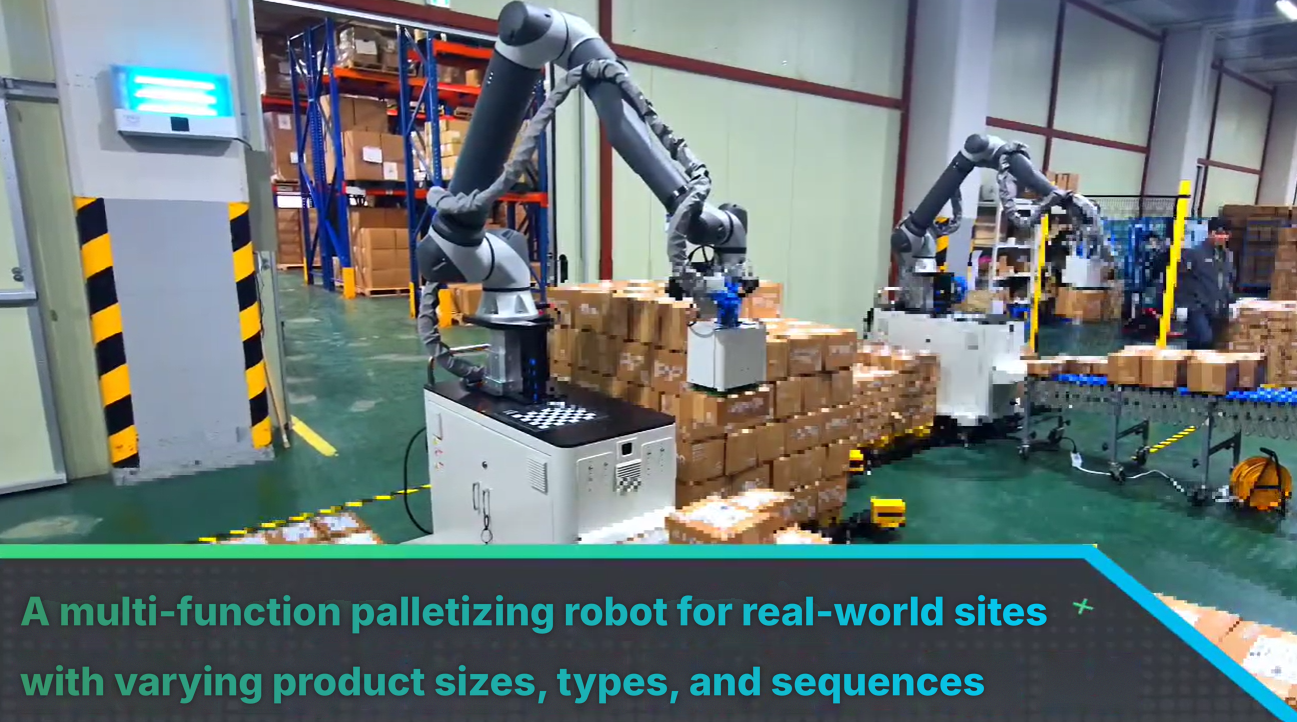
ROBOE Technologies has developed and implemented robotic palletizing and logistics automation solutions across a variety of industries using collaborative robots with payload capacities of up to 20 kg.
By combining robotic hardware with proprietary software technologies, including 3D vision and process simulation, ROBOE helps businesses address the practical challenges of automation deployment. Its software capabilities support the recognition of different box dimensions, adaptive stacking strategies, and remote monitoring, helping minimize discrepancies between system design and actual operating conditions. Through proprietary software and AI-powered box recognition technology, ROBOE has achieved pallet space utilization rates of up to 85% in applicable configurations, helping increase the number of boxes handled per pallet.
ROBOE also develops and supplies its own robotic platforms. Its product portfolio includes the CBR (Cart-type Box Handling Robot), a portable robotic palletizing solution, and the MGR, a robotic unloading solution. Unlike conventional fixed robotic palletizing systems, ROBOE's portable platforms offer greater flexibility in installation and relocation, allowing businesses to adapt their automation systems to changing operational requirements. ROBOE's solutions have been applied across multiple industries, including logistics, food and beverage, and apparel, both domestically and internationally. In one recent project, ROBOE successfully implemented a robotic palletizing line using four of its own robotic platforms within a limited packaging and material-handling area.
The system automates the palletizing of finished product boxes after production and packaging, demonstrating how robotic automation can be implemented even in facilities with restricted floor space.
What Should Businesses Consider Before Implementing Palletizing Automation?
The challenges of palletizing automation are not limited to robot prices or technical specifications. The real challenge is transforming tasks that human workers perform through experience and judgment into processes that robots can execute reliably and consistently.
Achieving this requires a thorough understanding of the facility's operating conditions and the design of an appropriate automation system. Rather than beginning with robot model comparisons or equipment prices, businesses should first identify the characteristics of their existing processes and clearly define their automation objectives.
The following checklist can help determine the feasibility and complexity of a palletizing automation project.
Palletizing Automation Readiness Checklist
Palletizing automation should not be viewed simply as purchasing and installing a robot. Instead, it should be approached as a process improvement initiative aimed at reducing inefficiencies throughout the existing logistics operation.
Before implementation, consider the following questions:
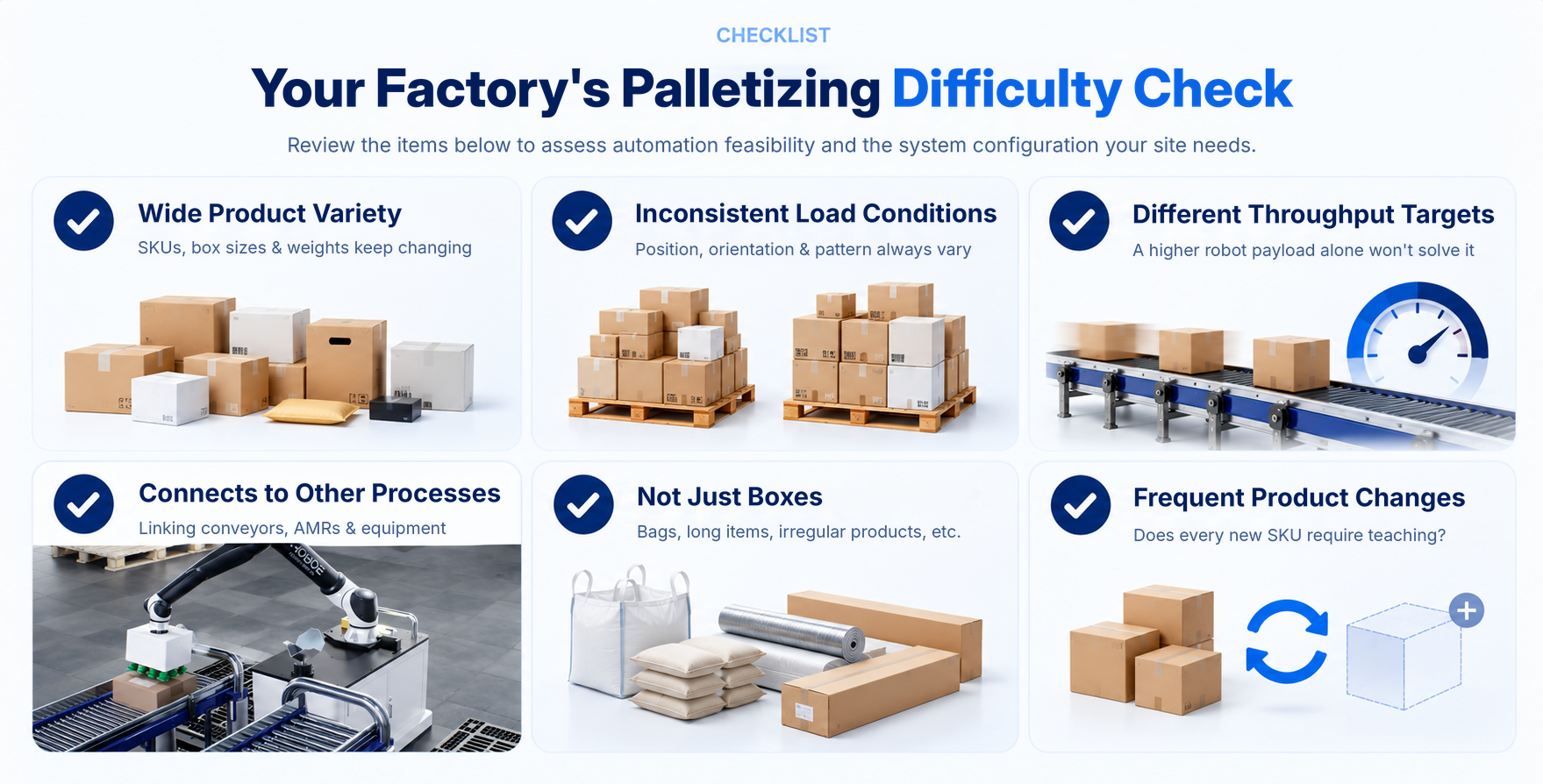
These factors directly influence system configuration, implementation costs, and actual operating productivity. For facilities handling boxes of different sizes or requiring integration with existing equipment, preliminary 3D process simulation can be particularly valuable. Simulation enables businesses to evaluate robot working ranges, potential equipment interference, and estimated throughput before committing to installation.
Ultimately, successful palletizing automation begins not with installing a robot, but with integrating the right hardware and software to optimize the entire process according to the facility's specific operating requirements.